The best deals ever
How Disney's $7.4 billion Pixar deal saved its animation empire
In 2006 a brand-new Disney boss paid a hefty price for the studio that had been beating Disney at its own game, and it may be the best deal he ever made.
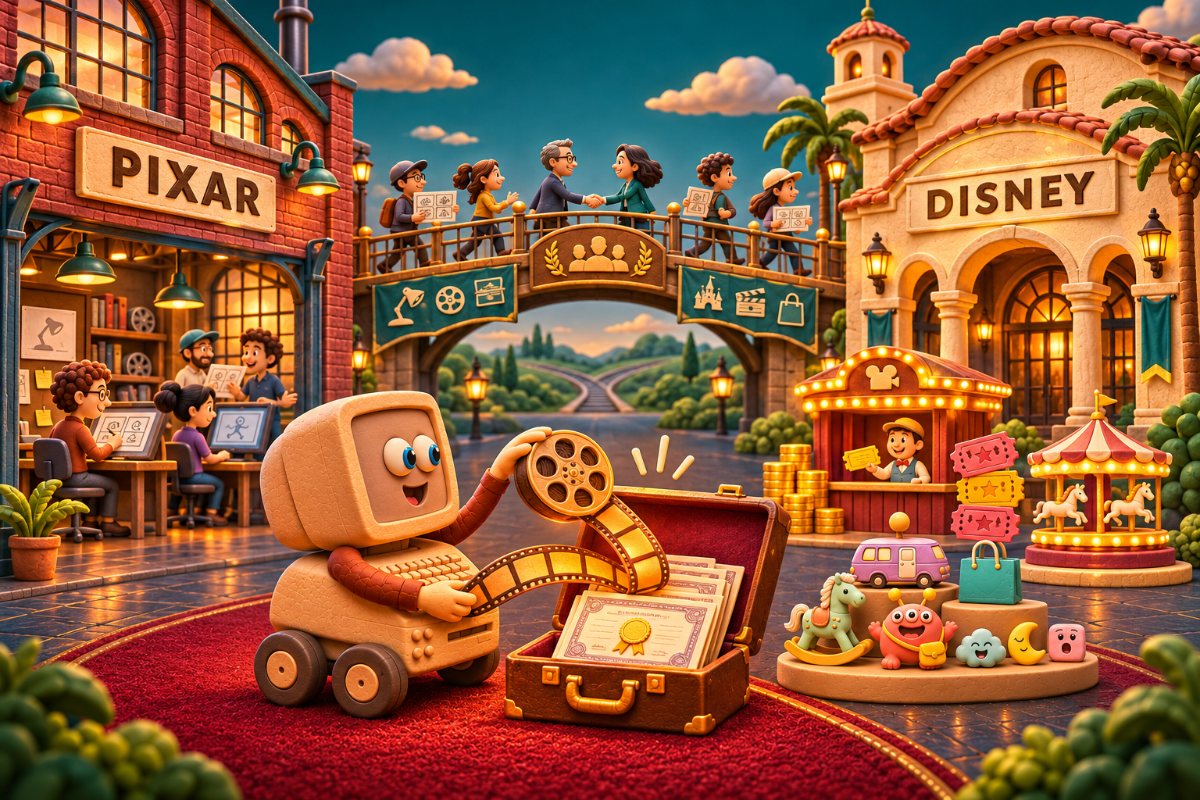
By 2004 the company that invented the animated feature film had lost its touch, and the hits were coming from a partner in Emeryville, California, run by Steve Jobs, who no longer wanted to work with Disney's boss. Two years later Disney bought that partner for $7.4 billion, a price many on Wall Street thought was too high. Here is how a feud became one of the best deals in media history.
Watch the story
By the numbers
- Price paid (all stock)
- $7.4B
- Price net of Pixar's cash
- About $6.4B
- Exchange ratio
- 2.3 Disney shares per Pixar share
- Pixar box office before the deal
- About $3.3B
- Pixar box office after the deal (to 2021)
- About $11.5B
- Disney market value at close vs. 2014
- $62B to $155B+
The deal
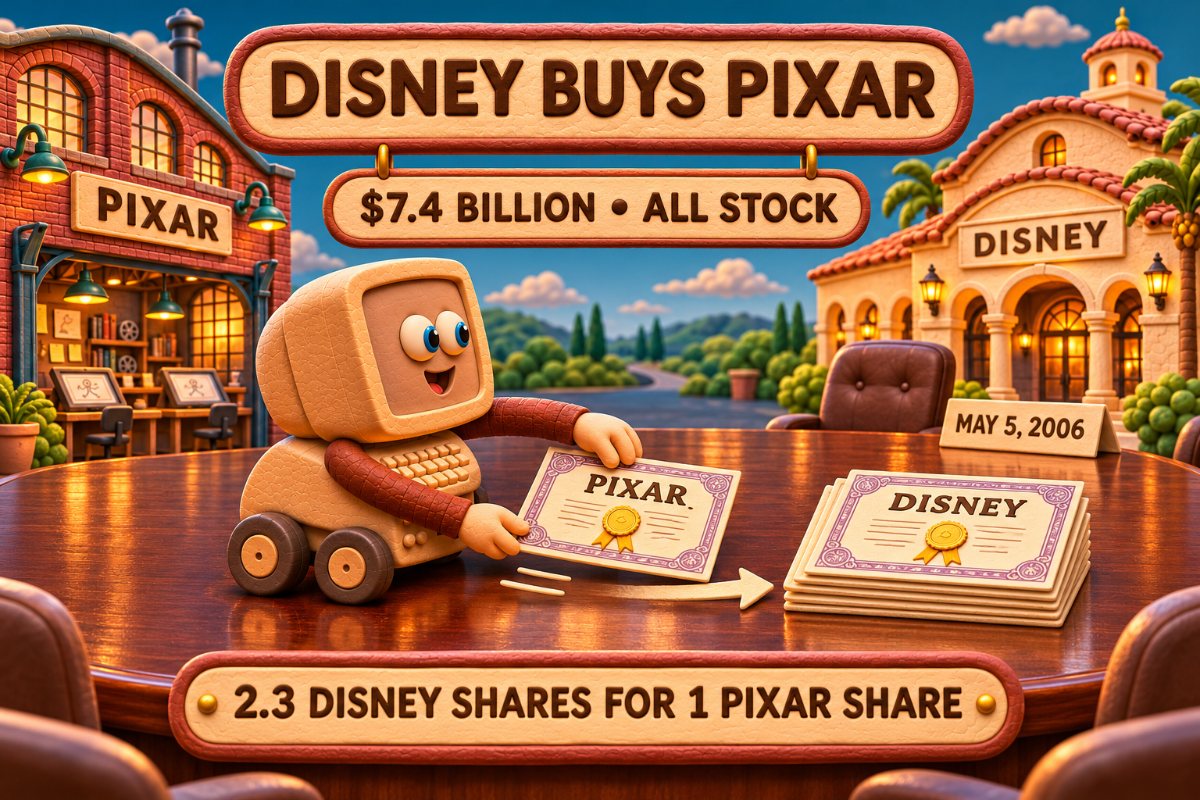
On January 24, 2006, The Walt Disney Company agreed to buy Pixar Animation Studios, the maker of Toy Story and Finding Nemo, for about $7.4 billion. That is roughly $11 billion to $12 billion in today's money, using a rough adjustment for consumer-price inflation. No cash changed hands. It was an all-stock deal: Pixar shareholders received 2.3 Disney shares for each Pixar share they held. At the closing prices on the day it was announced, that valued Pixar at $59.78 a share, only about 4% above where its stock was already trading. Disney issued about 288 million new shares, and its own accounts put the final purchase price at $7.5 billion, or $6.4 billion after counting the roughly $1.1 billion of cash and investments sitting on Pixar's balance sheet. Pixar shareholders approved the deal and it closed on May 5, 2006. Steve Jobs, who owned about half of Pixar, became Disney's largest individual shareholder, with roughly 7% of the company, and took a seat on its board.
The backstory
Disney and Pixar had been partners for more than a decade. Pixar made the films; Disney distributed them and took a share of the profits. Pixar was a Jobs bet that had paid off spectacularly. He had bought the computer-graphics division from George Lucas's company for $10 million in 1986, and after Toy Story's release in 1995 Pixar went public and ended its first full day of trading worth about $1.5 billion. Meanwhile Disney's own animation studio, which had made The Lion King and Aladdin in the 1990s, was struggling to make hits, and DreamWorks Animation was competing hard in computer-animated films. The partnership broke down under Disney's chief executive, Michael Eisner, who did not get along with Jobs. Eisner would not offer Pixar a better deal than its 50-50 split of profits. In January 2004, after about 10 months of talks, Jobs walked away and said Pixar would look for a new distributor. On a call with analysts he took shots at Eisner and said a return to talks was "unlikely." The existing deal would end with Cars in 2006. What changed was the man at the top. Bob Iger became Disney's chief executive on September 30, 2005, and made patching things up with Pixar a top priority. Within two months of telling investors he would be "disciplined" about acquisitions, he announced the purchase. Shortly before the deal, analysts were still betting on a new distribution agreement instead. An outright purchase, they argued, would cost $8.4 billion to $12 billion and would hurt Disney's stock and earnings.
By the numbers
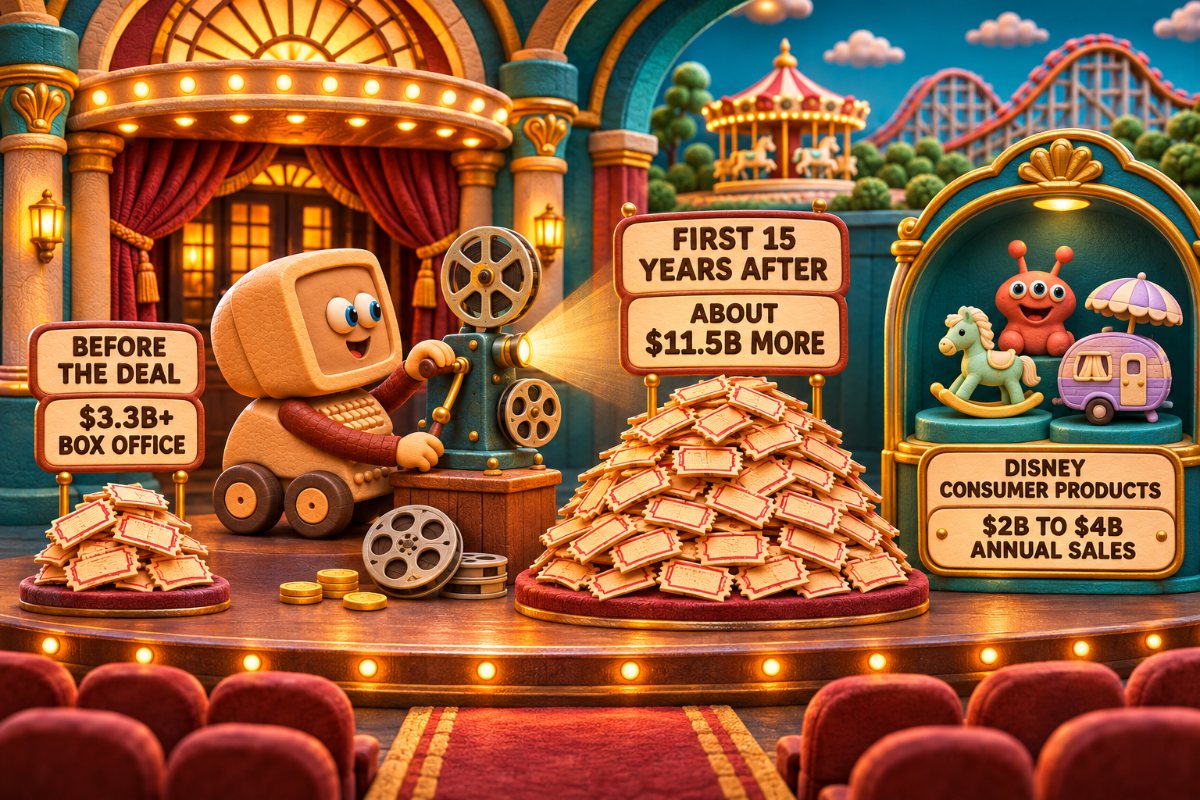
Before the deal, Pixar's films had taken just over $3.3 billion at the global box office. In the 15 years after it, according to Comscore data cited by CNBC in 2021, they added about $11.5 billion more. That is more than one and a half times the price Disney paid, from ticket sales alone. Toy Story 3 (2010) became the first animated film to pass $1 billion worldwide. In 2024 Inside Out 2 became Pixar's biggest film ever, with more than $1.25 billion worldwide. The box office was only part of the payoff. Every Pixar character also fed Disney's merchandise and theme parks. By 2014, Disney's consumer products business had annual sales of about $4 billion, up from about $2 billion when the deal was done. Investors did well too. Disney's market value rose from just over $62 billion when the deal closed to more than $155 billion by late 2014. Over Iger's whole first run as chief executive, from 2005 to 2020, Disney's market value grew from about $49 billion to about $231 billion. Pixar was not the only reason for that growth, but it was the deal that started it.
Why it worked
Disney was not simply buying a film library. It was buying the people and the way of working that made the films. So the deal was built to protect Pixar rather than absorb it. Pixar stayed in Emeryville and kept its brand. In his announcement Iger promised that Disney would "welcome and embrace Pixar's unique culture." Then he went further and put Pixar's leaders in charge of Disney's own animation. John Lasseter, a former Disney animator and Pixar's creative force, became chief creative officer of both studios. Pixar's president, Ed Catmull, became president of both. The two studios were kept separate, but Disney Animation now had Pixar's leaders running it. That decision paid off well beyond Pixar's own films. Disney's in-house studio went on to make Tangled, Wreck-It Ralph, Frozen, Zootopia and Moana. Iger later said that everything Disney Animation achieved after 2006 "was tied to the Pixar acquisition." Owning Pixar outright also meant Disney kept all of the profits from future Pixar films instead of splitting them. And the deal gave Iger a track record. He said Pixar's experience helped convince other companies, such as Marvel, that they would not lose their identity inside Disney. Looking back in 2021, he called Pixar "probably the best" acquisition of his time as CEO.
What almost went wrong
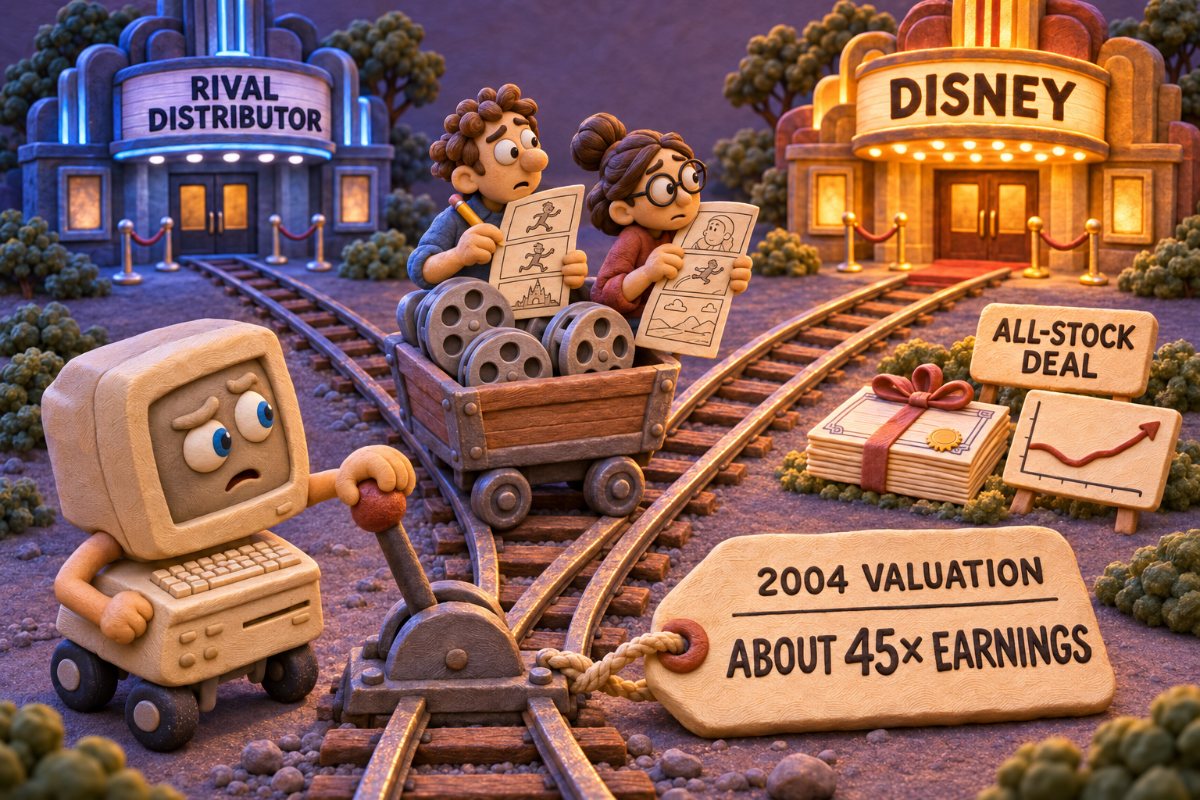
The deal very nearly never happened. In 2004 the partnership had collapsed so badly that Iger, then Disney's president, said publicly that another deal with Pixar was unlikely and that "if it's not Pixar, it will be someone else." If Jobs had found another distributor, Disney would have lost its best source of animated hits to a rival. The price was also a real worry. Pixar's stock was already expensive. In 2004 most analysts thought it overvalued at about 45 times earnings. When the deal was announced, some analysts thought Disney had overpaid, and CNBC later reported that even Disney's board and its former CEO had doubts. Disney's finance chief, Tom Staggs, admitted the deal would slightly reduce earnings in 2006 and 2007 before adding to them from 2008. Then there was the risk that the merger would destroy what Disney was paying for. Creative companies often lose their best people after a takeover, and even analysts who liked the deal warned on NPR that it might not work out. Using stock instead of cash helped. Jobs, who had agreed to vote 40% of Pixar's shares in favor, was now Disney's biggest individual shareholder. He had every reason to want the deal to work. One investor summed up the case for the price: the real question was "how expensive would it have been for Disney if Pixar fell into someone else's hands."
The lesson
When the main asset is talent, the price matters less than keeping that talent. Disney paid a full price, and its earnings took a short-term hit. But it protected the culture it was buying and then let the people it bought take charge of its own struggling studio. Dealmakers also point to the defensive logic: sometimes the costliest choice is letting a rival buy the business instead. And when a relationship has gone sour, a change of leader can make a deal possible that seemed out of reach.
Sources (all free to read)
Today's deals, every morning
The day's biggest deals in five minutes, plus a new Greatest Deals story every week. Free.