The worst deals ever
HP–Autonomy: the $11 billion software bet that HP wrote down by $8.8 billion a year later
Hewlett-Packard paid a 64% premium for Britain's biggest software company, and 14 months later said most of that money was gone.
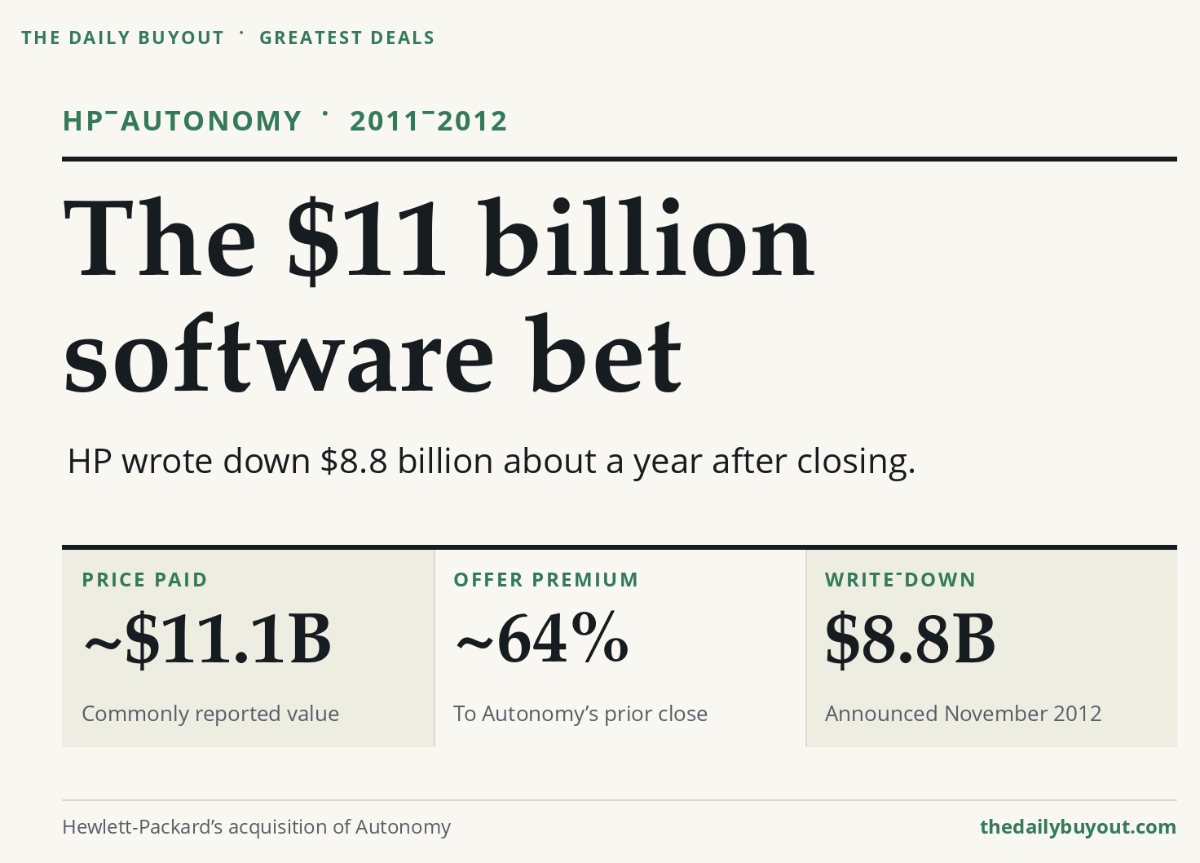
On 18 August 2011, the world's biggest computer maker said it was getting out of tablets, might sell its PC business, and would spend about $11 billion on a Cambridge software company most of its customers had never heard of. The next day its shares fell 20%. Within a month the CEO who planned the deal had been fired. Within 15 months most of the purchase price had been written off. The lawsuits ran for 13 years after that.
By the numbers
- Price paid
- About $11.1B (£25.50/share)
- Premium to prior close
- About 64%
- Autonomy's 2010 sales
- About $870M
- Write-down (Nov 2012)
- $8.8B
- HP shares, day after announcement
- -20%
- UK damages awarded (2025)
- About £700M (~$943M)
The deal
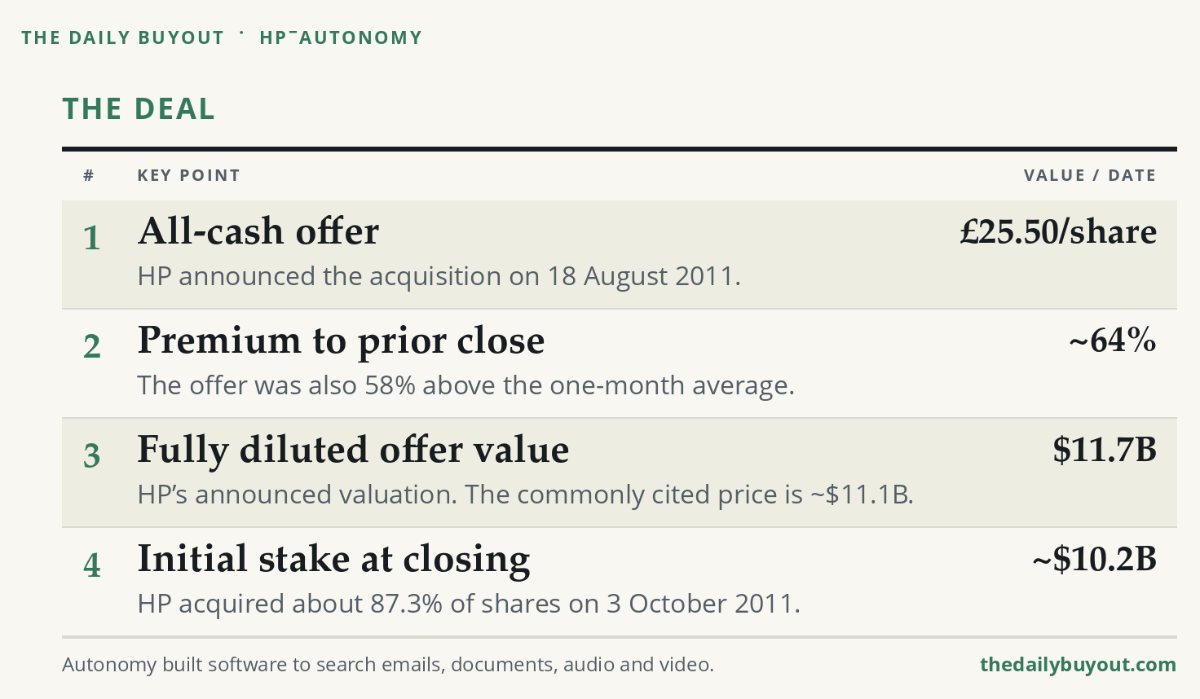
Hewlett-Packard agreed on 18 August 2011 to buy Autonomy Corporation, a British enterprise software company, for $42.11 (£25.50) a share, all in cash. HP said the offer valued Autonomy at about $11.7 billion on a fully diluted basis. The figure most often quoted is about $11.1 billion, and some reports put the cash outlay at about $10.2 billion, so the headline numbers vary depending on what is counted. When the deal closed on 3 October 2011, HP said it had acquired about 87.3% of the shares for around $10.2 billion. The price was about 64% above Autonomy's closing share price the day before the announcement, and about 58% above its one-month average. Adjusted for inflation since 2011, $11 billion is roughly $16 billion today. That is an approximation, not a figure from a source. Autonomy was founded in Cambridge, England, in 1996 by Mike Lynch and Richard Gaunt. It became Britain's biggest software company and joined the FTSE 100. Its products searched and made sense of unstructured data such as emails, documents, audio and video. Today that would be called big data or enterprise AI.
The backstory
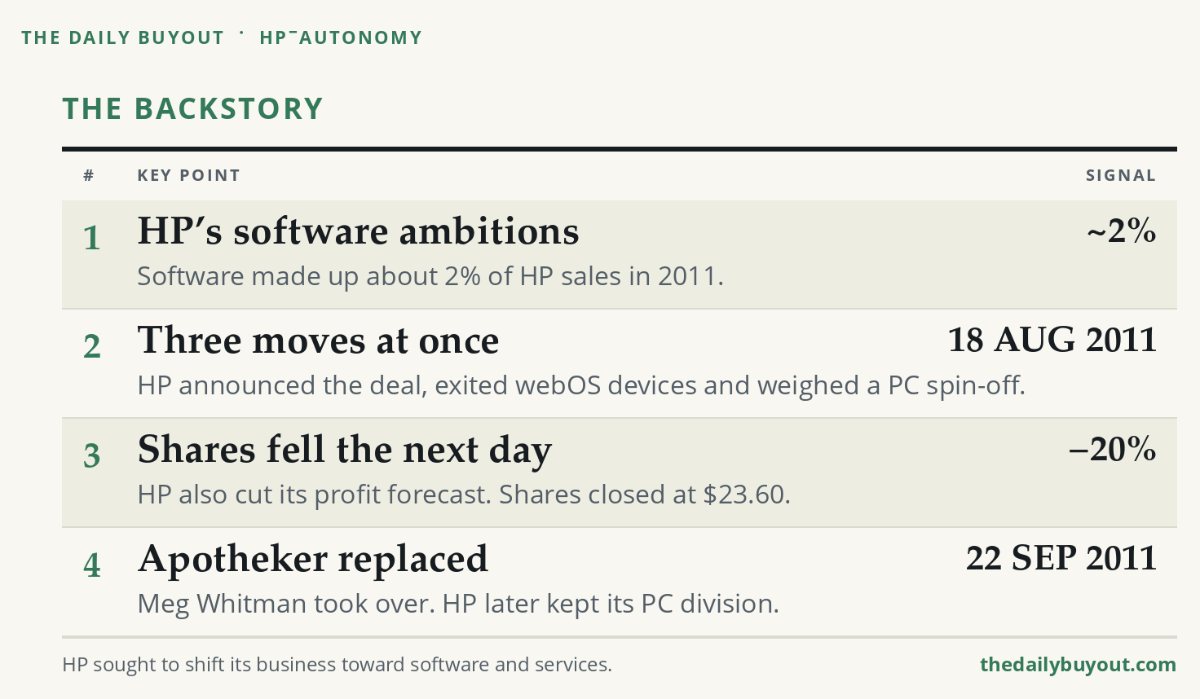
The deal was driven by Léo Apotheker, the former CEO of SAP, who took over at HP in late 2010. He wanted to move HP away from hardware, which was low-margin and increasingly commoditised, and towards software and services, as IBM had done. In 2011 software made up only about 2% of HP's sales, so Autonomy was meant to give HP an instant position in high-value business software. In HP's announcement Apotheker said Autonomy presented "an opportunity to accelerate our strategic vision" and called it "a highly profitable and globally respected software company." The market reacted badly, mostly because of what HP announced on the same day. It said it would shut down the webOS tablet and phone business it had bought with Palm, and that it was considering spinning off its PC division, which brought in nearly a third of its revenue. It also cut its profit forecast. On 19 August HP stock fell $5.91, or 20%, to $23.60, its lowest level since 2005 and below its low point in the 2009 financial crisis. One trade publication noted that Autonomy would add only about one percent to HP's revenue at first, and reporters asked Apotheker directly whether the price was too high. HP's board had approved the deal unanimously. On 22 September 2011, a few weeks after the announcement, the same board fired Apotheker and replaced him with board member Meg Whitman. HP later dropped the plan to spin off its PCs.
By the numbers
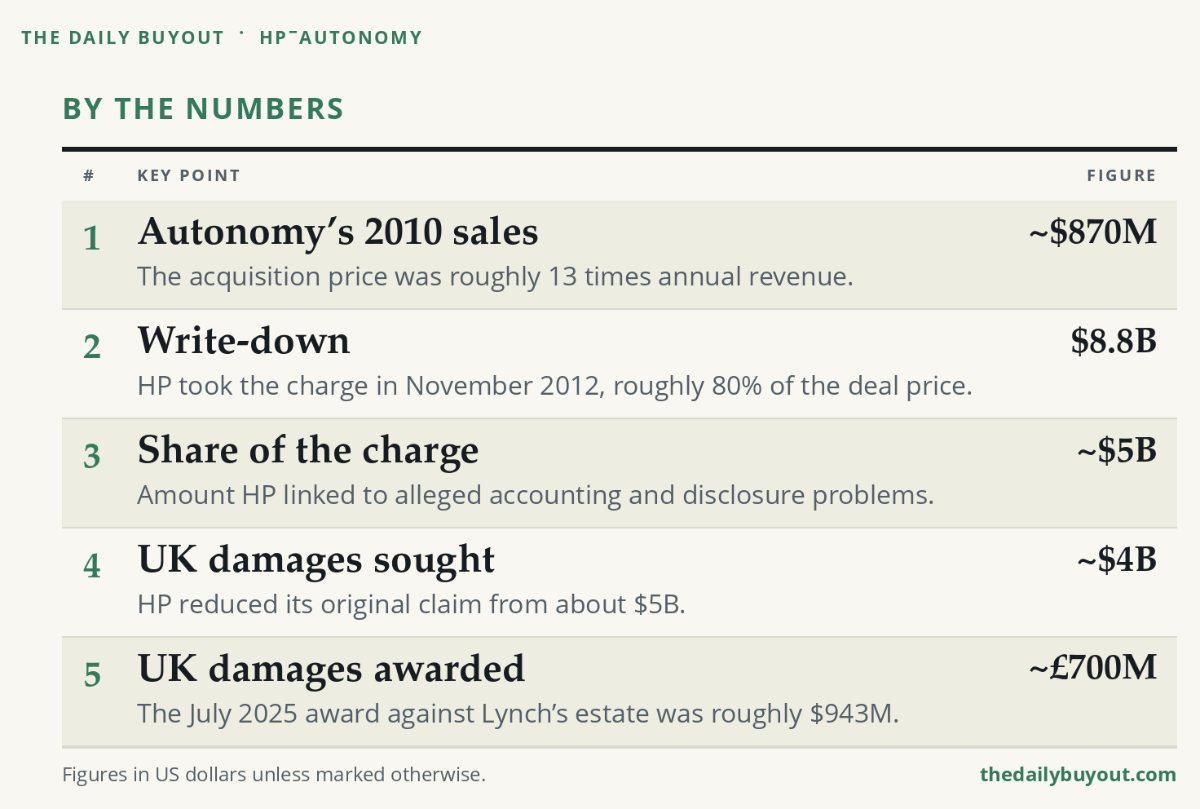
HP paid about $11 billion for a company that reported about $870 million in sales the year before, or roughly 13 times revenue. Most of the price was therefore booked as goodwill: the premium paid above the value of the business's identifiable assets. On 20 November 2012, Whitman's HP took an $8.8 billion charge against Autonomy, writing off about 80% of the purchase price. HP said there had been "serious accounting improprieties, disclosure failures and outright misrepresentations" at Autonomy. It linked about $5 billion of the charge to those problems and the rest to factors including its own falling share price. The charge erased HP's profit for the period, and its shares fell 12% to around a 10-year low. That was on top of the roughly 40% the stock had lost during Apotheker's short time as CEO. HP then spent years trying to recover the money. It first sought about $5 billion in damages in London's High Court and later reduced the claim to about $4 billion. In July 2025 the judge awarded about £700 million, roughly $943 million, against Lynch's estate. That is about a fifth of what HP had sought and a small fraction of the $8.8 billion it wrote off.
Why it failed
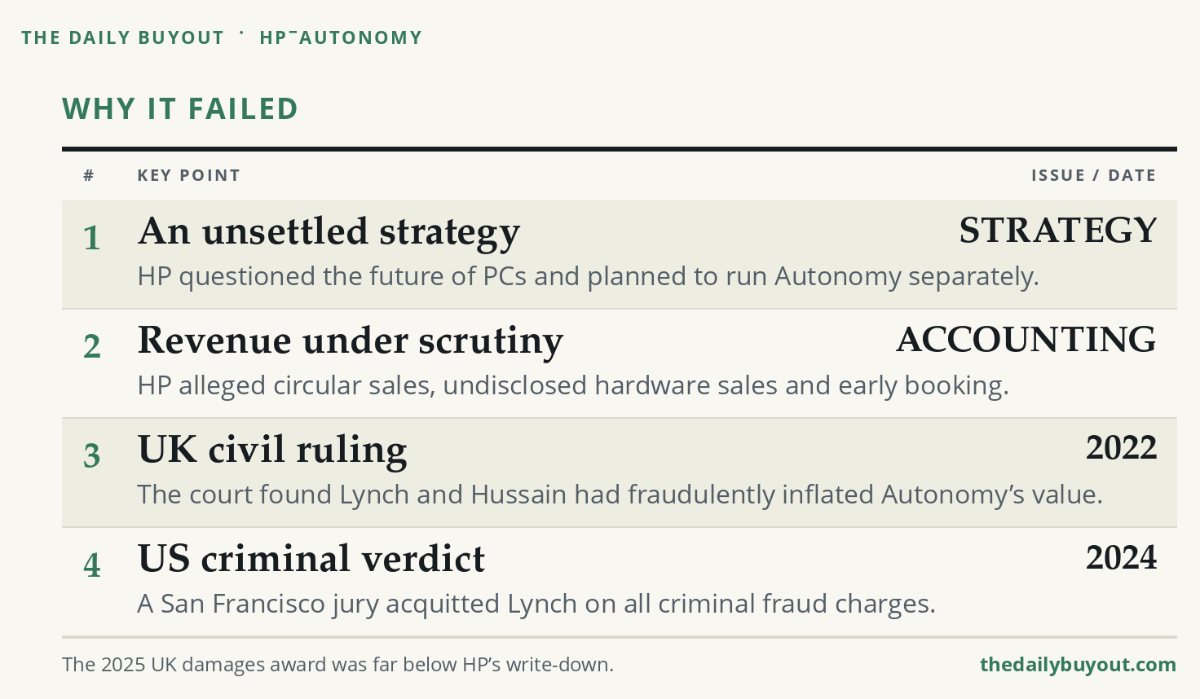
Two things went wrong: the strategy and the target. On strategy, HP tried to change its whole business on a single day. It announced it might leave PCs, closed its mobile business, and made its largest software purchase so far, all at once. Investors could not see how the pieces fitted together, and HP said Autonomy would be run as a separate company. A deal meant to turn a hardware giant into a software company had very little support from HP's own investors. On the target, HP said in 2012 that the business it bought was smaller and less profitable than Autonomy's accounts showed. In the London civil case, HP alleged that Autonomy had passed money in circles through customers and resellers to create apparent revenue. It also alleged that Autonomy sold hundreds of millions of dollars of low-margin hardware without disclosing it separately, and that revenue from multi-year support contracts was recorded all at once instead of over time. In 2022 Mr Justice Hildyard ruled that Lynch and his finance chief, Sushovan Hussain, had fraudulently inflated Autonomy's value. Hussain had already been convicted in a US criminal trial in 2018 and sentenced to five years in prison. Lynch disputed this throughout. He argued that Autonomy's problems came from HP's management of the business after the purchase, and he called HP's write-down an "attempt to set the bar so low that you can't possibly fail." In June 2024 a San Francisco jury acquitted him of all criminal fraud charges after a three-month trial in which Apotheker gave evidence. Two months later Lynch died at 59 when his yacht sank in a storm. After the 2025 damages ruling, a statement Lynch had written before his death said HP's damages claim had been "off the mark by 80%." The court refused his estate permission to appeal. Courts disagreed about Lynch's personal responsibility, but they were consistent on the money. Even the court that found fraud judged that the overpayment caused by deception was much smaller than HP's $8.8 billion write-down. Much of the loss came from HP's own decision to pay so much.
What could have saved it
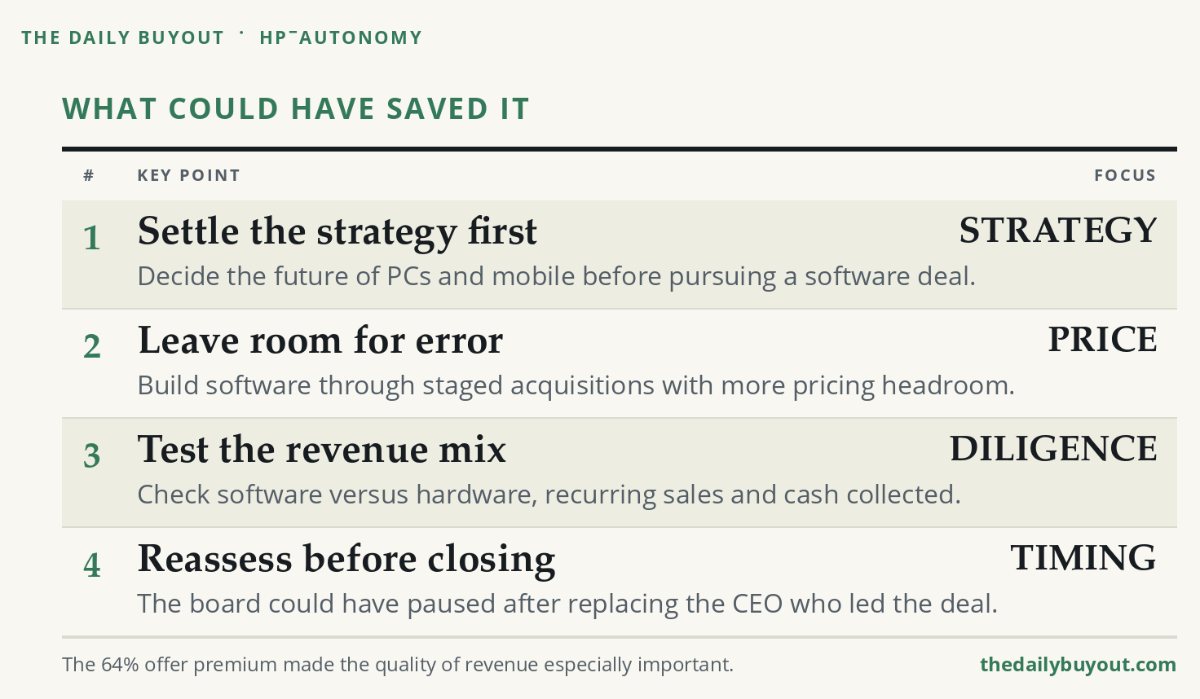
There were warning signs before the deal closed. HP's shareholders rejected the overall plan within a day. A 64% premium for a company with under $1 billion in sales required everything to go right. Autonomy's mix of software and hardware revenue was hard to see from its published accounts, which is exactly the kind of thing due diligence should uncover. Accounting experts later noted that HP had relied heavily on Autonomy's audited financial statements. HP itself said later that the write-down reflected a lack of due diligence while Apotheker was CEO. After the write-down, HP's shareholders sued the board, the auditors and the deal advisers, alleging that HP had grossly overpaid. A better approach would have started with HP's own business. That would have meant settling what to do with PCs and mobile first, then making software acquisitions in stages, at prices that left room for error. Diligence should have tested the quality of Autonomy's revenue, not just its total: what was software, what was hardware, what was recurring, and how much cash it actually collected. HP also had the option to walk away. Between the August announcement and the October closing, its CEO was fired and its strategy was in doubt. A board that had lost confidence in its CEO could have paused the deal he had planned.
The lesson
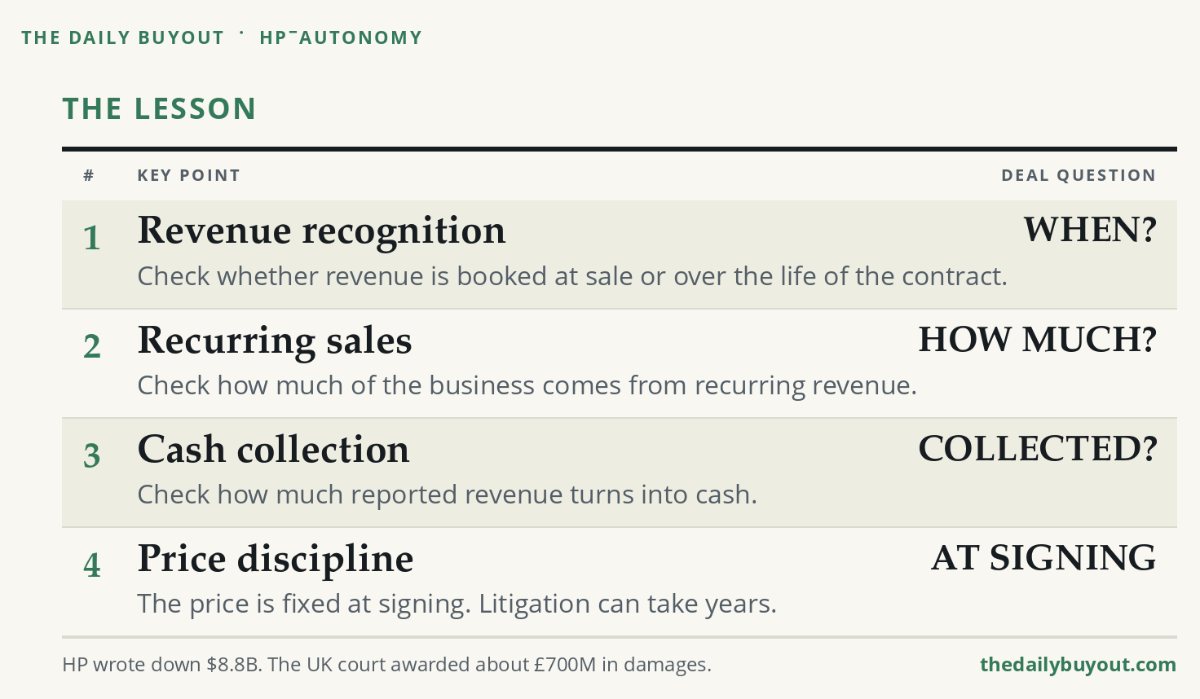
A strategy change cannot simply be bought, especially when the purchase depends on numbers the buyer has not properly tested. In software deals, dealmakers still use Autonomy as a reminder to check the quality of revenue: how it is recognised, how much is recurring, and whether it turns into cash. Fraud claims can take years to resolve, but the price is fixed on the day the deal is signed. HP showed that a buyer can win most of its case in court and still lose most of its money.
Sources (all free to read)
Today's deals, every morning
The day's biggest deals in five minutes, plus a new Greatest Deals story every week. Free.